Table of Contents
You’ve signed an offer from a UAE company and the start date is set. Now the questions begin. What does your employer apply for? When do you fly? And which of the cards and permits people keep mentioning do you actually need?
Here’s the short version. Your employer gets a work permit approved, you enter the UAE (or change your status if you’re already here), take a medical test, and your residence visa and Emirates ID are issued together. This guide walks through the UAE employment visa process one step at a time, for both new hires and the employers sponsoring them.
Work Permit, Entry Permit, Residence Visa and Emirates ID: What Each One Is
These four are often used as if they mean the same thing. They don’t, and knowing the difference makes the process much easier to follow.
|
Document |
What it does |
Who issues it |
|
Work permit |
Allows you to work for a specific employer |
MOHRE for mainland companies; the free zone authority for free zone companies |
|
Entry permit |
Lets you enter the UAE to complete your visa. If you’re already in the country, a change of status permit is used instead |
Immigration authorities (ICP, or GDRFA in Dubai) |
|
Residence visa |
Lets you live in the UAE, usually for two years |
ICP or GDRFA |
|
Emirates ID |
Your identity card and, since April 2022, your proof of residence |
ICP |
The work permit comes first, and it matters: under UAE rules it is illegal to work without one. Your employer applies for it, not you. The type of permit also depends on your situation. Someone hired from abroad, someone transferring from another UAE employer and someone on a family visa each go through a different permit route.
The UAE Employment Visa Process, Step by Step
The order below follows the official Dubai process for mainland employers. Other emirates follow the same broad sequence, though the platforms and centres differ.
Step 1: Job Offer and Work Permit Approval
It starts with a formal offer. For hires from outside the UAE, MOHRE asks for its official job offer form, signed by both the employer and the employee.
The employer then applies for the work permit. To do that, the company needs a valid trade licence without violations and an available visa quota. You’ll usually be asked for a passport copy valid for at least six months, a photo with a white background and, for more senior roles, your academic certificates. Some professions, such as healthcare and teaching, also need a licence from the relevant authority.
Step 2: Entry Permit or Change of Status
Once the work permit is approved, an entry permit is issued. You then have 60 days to enter the UAE and complete the process.
Already in the UAE, for example on a visit visa? Your employer applies for a change of status instead, so you don’t need to leave the country and come back.
Step 3: Health Insurance
This step often gets left until the end, but it needs to be in place earlier. From 1 January 2025, private-sector employers in every emirate must provide at least basic health insurance before a residence permit is issued or renewed (MOHRE). Your employer arranges and pays for this cover.
Step 4: Medical Fitness Test
Everyone aged 18 or over applying for residence must pass a medical fitness test at a government-approved centre in the emirate issuing the visa. It usually involves a blood test and a chest X-ray, screening for communicable diseases such as tuberculosis, HIV and hepatitis. Some nationalities also need a medical check in their home country before travelling.
Step 5: Residence Visa and Emirates ID
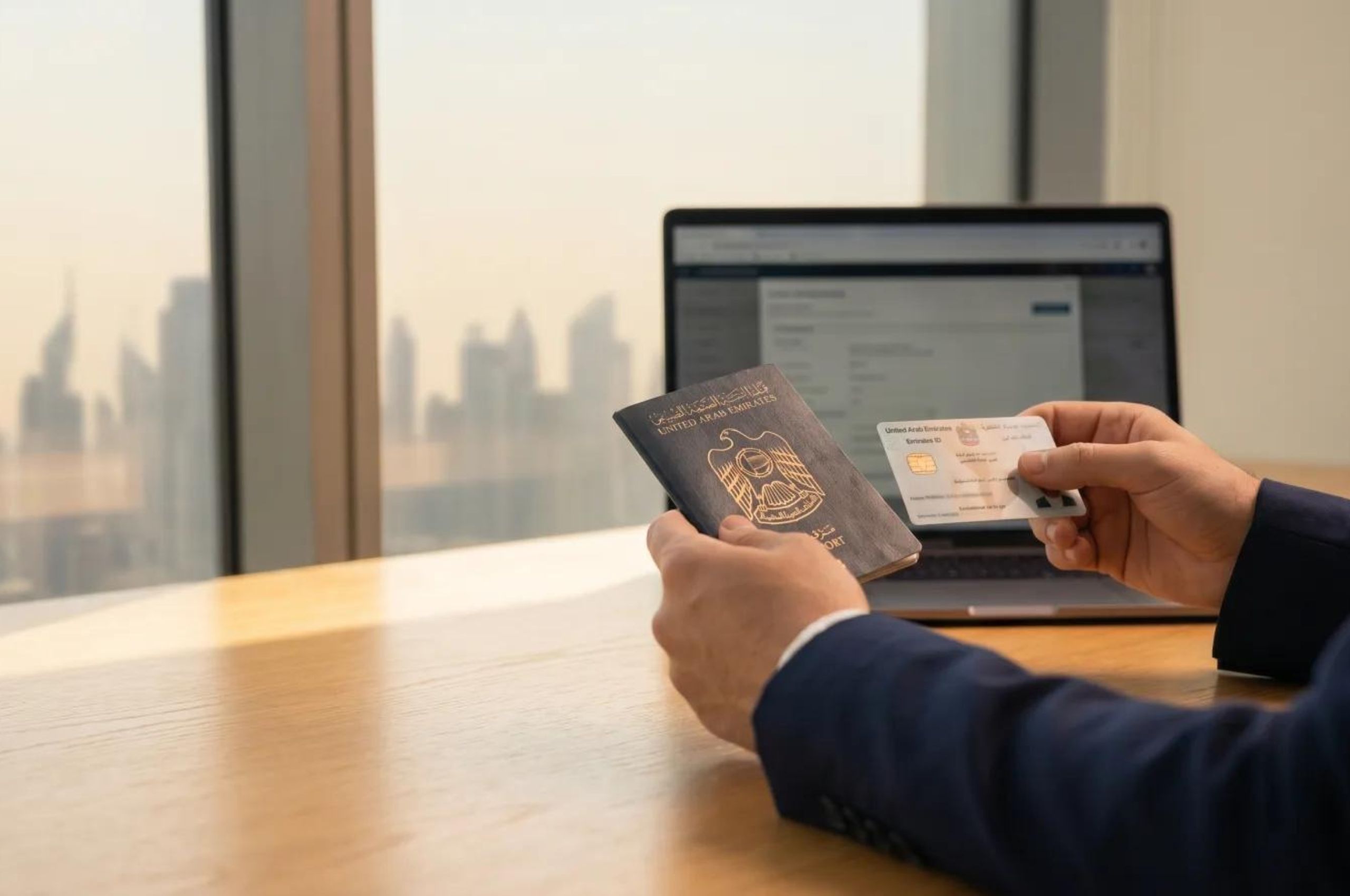
After your medical result is released, the residence visa and Emirates ID are applied for together. From April 2022 they share a single application, and the Emirates ID replaces the old visa sticker in your passport as proof of residence (ICP).
You’ll need to give fingerprints and a photo for the Emirates ID unless you already have biometrics on file. The residence visa is normally valid for two years and can be renewed.
A Note on the Work Bundle
In Dubai, much of this now runs through the Work Bundle platform, which brings the work permit, residence, medical and Emirates ID steps together and cuts the process from 15 steps to 5. Employers use it; as an employee, you’ll mostly notice fewer visits.
How the Process Differs in a Free Zone
If your employer is a free zone company, the same stages apply, but the free zone authority runs the process through its own portal instead of MOHRE. Many free zones also have their own medical and biometrics arrangements.
Some free zones issue the residence visa and Emirates ID digitally, and documents and timelines vary from zone to zone, so check with the specific authority. If you’re an employer still choosing where to register, our guide to setting up in a free zone covers the trade-offs.
Documents Usually Needed
Exact requirements depend on the job, the employer and the authority, but most applications ask for the following.
From the employee:
- Passport valid for at least six months
- Passport-size photo with a white background
- Signed job offer
- Attested educational certificates, for roles that need them
- Professional licence, for regulated jobs such as healthcare or teaching
From the employer:
- Valid trade licence
- Establishment card or immigration file
- Available visa quota
- Health insurance for the employee
Certificates issued outside the UAE usually need attestation before they’re accepted. If you haven’t done this before, here’s how certificate attestation works, or see degree certificate attestation if that’s the document you need. Start early: attestation in your home country often takes longer than the visa itself.
How Long the Process Takes
There’s no single timeline, because each stage is handled by a different authority. As a guide, MOHRE lists two working days to process an overseas work permit, and Dubai.ae says the residence visa is issued within 48 hours once the medical result is out.
What usually adds time is everything around those steps: waiting on attested certificates, travel arrangements within the 60-day entry window, booking the medical, or a retest. Free zone timelines vary by zone and package.
Who Pays for an Employment Visa?
The employer does. Article 6(4) of the UAE Labour Law (Federal Decree-Law No. 33 of 2021) bars employers from charging workers recruitment or employment costs, directly or indirectly. Separately, the employer must also pay for the basic health insurance.
If you’re asked to pay for your own visa, or see it deducted from your salary, you can raise it with MOHRE.
Common Reasons for Delays
Most hold-ups are avoidable with a bit of checking up front:
- Certificates that aren’t attested, or names that are spelled differently on the certificate and the passport
- A passport close to expiry, below the six months usually required
- Missing the 60-day window to enter the UAE on the entry permit
- A medical retest, which pushes back the residence application
- Employer-side issues, such as no available quota or a lapsed trade licence
Need Help With Employee Visas?
For employers, each new hire means a permit, an entry or status change, insurance, a medical and a residence application, all with their own deadlines. Express Group’s PRO services in the UAE handle employee visa applications, renewals and cancellations, so your team can focus on onboarding. Once your new employee has residence, they may want to sponsor their family too.